Thousands of workers in Ontario face preventable risk every day—not from fires or falls, but from machines that start unexpectedly during maintenance. A worker reaches into a jammed conveyor belt, bypasses a safety guard, and a miswired control sends the line back into motion. The outcome? Severe injury, costly downtime, and regulatory scrutiny. This is exactly the scenario Ontario’s lockout tagout (LOTO) regulations are designed to prevent.
Yet despite clear rules under the Occupational Health and Safety Act (OHSA) and its associated regulations, LOTO violations remain among the most cited safety infractions in Ontario workplaces. Why? Because compliance isn’t just about posting a sign or hanging a tag—it’s about a documented, enforceable system that protects lives and legal standing.
This guide breaks down Ontario’s lockout tagout regulations with precision, offering actionable clarity for safety officers, maintenance supervisors, and facility managers.
What Are Lockout Tagout Regulations in Ontario?
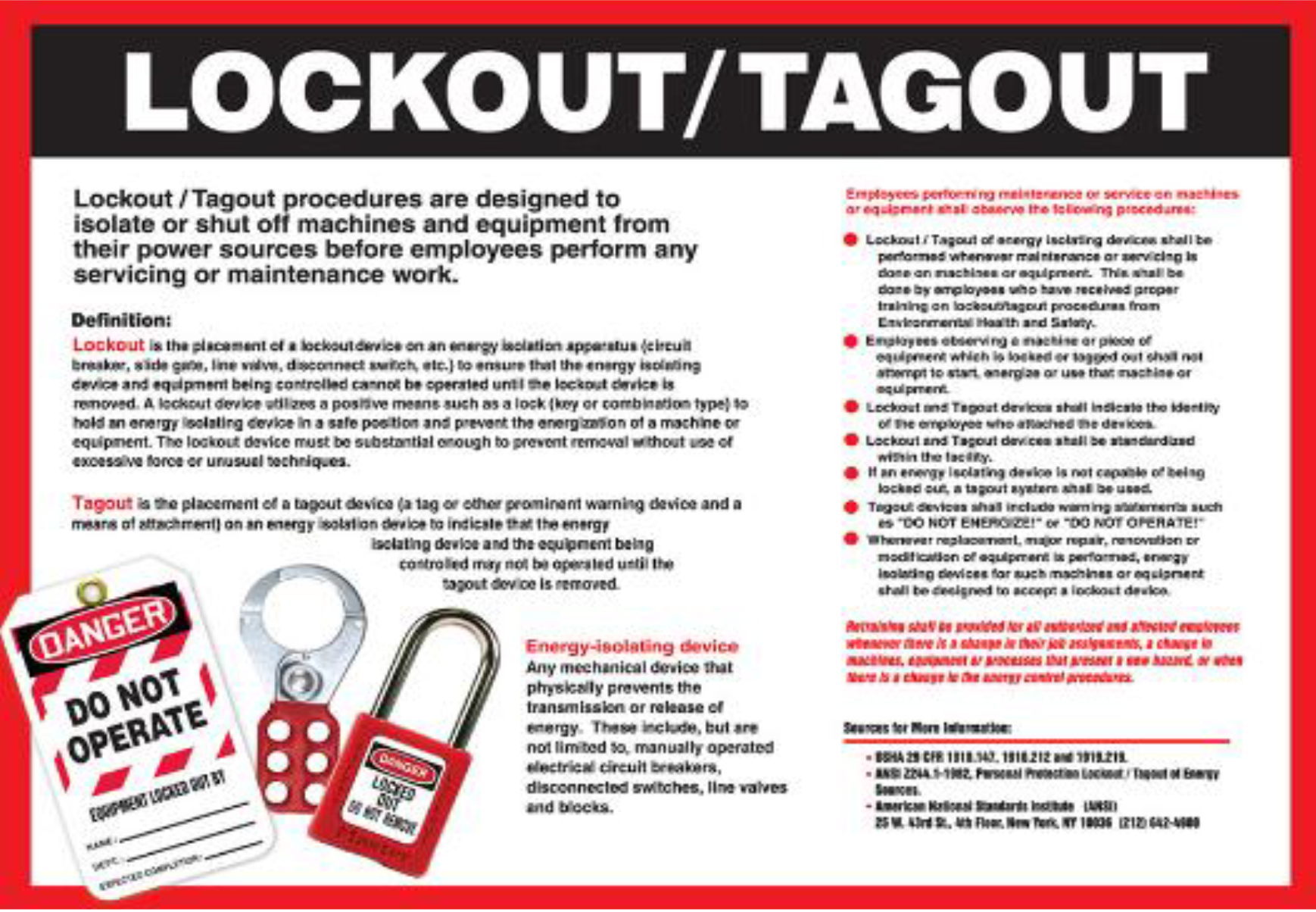
Ontario’s lockout tagout regulations are part of the province’s broader industrial safety framework, primarily governed by Regulation 851 (Industrial Establishments) and the Occupational Health and Safety Act (OHSA). These laws require employers to implement procedures that ensure machines and equipment are de-energized and rendered inoperative before any servicing or maintenance occurs.
LOTO is not a suggestion. It’s a legal obligation. Specifically:
- Section 75(1) of Regulation 851 states: “The employer shall ensure that measures are taken to prevent the machine, device or thing from being operated or from starting up when the machine, device or thing is being cleaned, repaired, adjusted or maintained.”
- Section 75(2) requires that energy-isolating devices be “locked out” using a lock and warning tag.
In practical terms, this means every energy source—electrical, hydraulic, pneumatic, gravitational, chemical—must be disconnected, secured, and verified before a worker begins any hands-on task.
Failure to comply can result in Ministry of Labour inspections, stop-work orders, and penalties under the OHSA, including fines up to $500,000 for corporations and potential jail time for individuals.
Key Requirements of Ontario LOTO Procedures
To meet Ontario’s legal standards, lockout tagout procedures must go beyond a basic checklist. They are part of a formal energy control program. Here’s what’s required:
1. Written LOTO Procedures
Every machine or process with hazardous energy exposure must have a documented procedure. These aren’t generic templates—they must be equipment-specific and include: - Identification of energy sources (e.g., 480V electrical feed, 120 psi air line) - Steps for shutting down and isolating energy - Method for verifying zero energy state - Who is authorized to perform lockout - Steps for safe re-energization
Example: A CNC press brake may have electrical, hydraulic, and stored spring energy. The procedure must account for all three, with steps to bleed hydraulic lines and block moving arms before lock application.
2. Authorized and Affected Workers
Regulation 851 distinguishes between two roles: - Authorized Workers: Those who perform maintenance and apply locks. They must be trained and certified. - Affected Workers: Those who operate or use the equipment but don’t service it. They must understand LOTO basics and never remove a lock that isn’t theirs.
Training records must be kept and refreshed regularly—especially after incidents or procedural changes.
3. Lockout Devices Must Be Durable and Standardized

Locks must be: - Unique to the individual (e.g., personal padlocks with employee ID) - Non-releasable without a key - Distinct from other locks used for non-safety purposes - Accompanied by a durable tag stating the worker’s name, date, and reason for lockout
Tags alone are not sufficient unless the equipment can only be isolated via tag (rare). Locks are mandatory where feasible.
4. Group Lockout Procedures
When multiple workers service one machine, a group lockout system is required. This typically involves: - A single primary lock applied by the lead authorized worker - Each additional worker applying their personal lock to a group lockbox or hasp - Verification that all locks are in place before work begins
This prevents premature re-energization and ensures individual accountability.
Real-World LOTO Violations in Ontario
Even experienced facilities make critical LOTO mistakes. Ministry of Labour reports reveal recurring issues:
- Using tags without locks – Tags are warnings, not control devices.
- Shared locks or master keys – Undermines personal accountability.
- No verification of zero energy – Workers assume power is off without testing.
- Improper isolation – Shutting off a switch but not disconnecting the power source.
- Skipping LOTO for minor tasks – “Just clearing a jam” leads to crushed hands.
Case Example: In 2022, a Brampton packaging plant was fined $75,000 after a worker lost three fingers replacing a roller on a conveyor. The investigation found that while a tag was present, the motor disconnect was not locked out, and no verification testing was done. The worker assumed the system was dead—but the control circuit remained live.
This incident underscores a key point: LOTO isn’t about paperwork. It’s about discipline, verification, and culture.
Steps to Implement Compliant LOTO in Your Workplace
Creating a compliant LOTO program isn’t a one-day project. It’s a process. Follow this workflow:
Step 1: Conduct an Energy Source Audit
Walk through every machine. Identify: - Electrical disconnects - Hydraulic/pneumatic valves - Gravity-fed components - Capacitors or springs that store energy
Document each with photos and diagrams.
Step 2: Develop Equipment-Specific Procedures
Use a standard template, but customize for each machine. Include: - Machine name and location - List of energy sources - Step-by-step shutdown and isolation - Required tools (e.g., lockout hasps, voltage tester) - Verification method (e.g., “Test for zero voltage using multimeter”)
Store procedures near equipment or in an accessible digital system.
Step 3: Train and Certify Workers
Training must cover: - How to read LOTO procedures - Difference between authorized and affected workers - How to apply and remove locks - Emergency response if someone is injured during maintenance
Keep training logs with dates, names, and signatures.
Step 4: Audit and Enforce
Conduct unannounced LOTO audits quarterly. Watch real workers perform lockout. Common gaps: - Skipping verification steps - Using someone else’s lock - Not locking out auxiliary systems
Correct immediately. Discipline misuse.
Common LOTO Mistakes and How to Avoid Them
Even high-performing workplaces slip up. Here’s how to stay sharp:
| Mistake | Risk | Solution |
|---|---|---|
| Using only a tag when a lock is possible | No physical barrier to startup | Install lockable disconnects |
| Not testing for zero energy | Assumption ≠ safety | Use voltage testers or pressure gauges |
| Locking out at control panel instead of power source | Residual energy remains | Isolate at the main disconnect |
| Leaving locks on after shift ends | “Ghost locks” create confusion | Use shift transfer procedures or lock removal logs |
| Allowing management override | Pressure to keep production running | Enforce policy: no exceptions |
Pro Tip: Use a “lockout logbook” or digital system to track who locked what and when. This is critical for shift changes and accountability.
LOTO Equipment and Tools for Ontario Compliance
You can’t enforce LOTO without the right tools. Invest in standardized, high-quality equipment:
- Personal Padlocks – Keyed-alike sets are a red flag. Each worker must have a unique, identifiable lock.
- Lockout Hasps – Allow multiple workers to apply locks to a single isolation point.
- Valve Lockouts – For hydraulic and pneumatic lines; ensure full shutoff.
- Circuit Breaker Locks – Fit over breaker switches to prevent flipping.
- Group Lockout Stations – Wall-mounted kits with locks, tags, hasps, and checklists.
Avoid cheap imports. Invest in CSA-compliant or equivalent devices built for industrial use.
Why LOTO Compliance Isn’t Just About Avoiding Fines
Yes, fines happen. But the real cost of LOTO failure is human. A single incident can: - End a career - Shatter team morale - Trigger months of investigation and scrutiny - Damage your company’s reputation
Conversely, a strong LOTO program signals that safety is non-negotiable. It builds trust, reduces downtime, and improves operational discipline.
More importantly, it aligns with Ontario’s “preventive” safety model—where the goal isn’t to react to harm, but to eliminate it before it happens.
Final Checklist for Ontario LOTO Compliance
Use this as a quick reference to assess your program:
- [ ] All machines have written, equipment-specific LOTO procedures
- [ ] Authorized workers are trained and documented
- [ ] Lockout devices are personal, durable, and standardized
- [ ] Tags are used only in conjunction with locks (unless allowed by exemption)
- [ ] Energy sources are verified zero before work begins
- [ ] Group lockout procedures are in place for complex maintenance
- [ ] Regular audits are conducted and records kept
If any box is unchecked, you’re at risk.
Compliance with Ontario lockout tagout regulations isn’t a box-ticking exercise. It’s a commitment to human safety backed by law. Build your program on documentation, verification, and accountability—and make sure every worker knows that no task is so urgent that it can’t be done safely.
Frequently Asked Questions
What is the difference between lockout and tagout in Ontario? Lockout physically isolates energy using a lock; tagout uses a warning tag. Tagout alone is only acceptable if the equipment can’t be locked out, and additional safety measures must be in place.
Who is responsible for LOTO compliance in Ontario? The employer is legally responsible, but supervisors and workers must also follow procedures. Ministry of Labour officers can issue orders to any party failing in their duty.
Do I need LOTO for minor maintenance tasks? Yes. If a worker places any part of their body into a point of operation or danger zone, LOTO is required—even for clearing jams or adjustments.
Can a manager remove a worker’s lock? Only under strict conditions: a formal removal procedure must be followed, including notification attempts, verification that the worker is not at risk, and documented justification.
Are there exceptions to LOTO in Ontario? Yes, limited exemptions exist for minor tool changes or routine tasks under specific conditions (e.g., using alternative protective measures like guarding), but these are narrowly defined under Regulation 851.
How often should LOTO procedures be reviewed? At minimum, annually, or whenever equipment changes, an incident occurs, or a new hazard is identified.
What training is required for authorized LOTO workers? Training must cover energy control procedures, recognition of hazardous energy, and the use of lockout devices. Refresher training is required at least every 3 years or after incidents.
FAQ
What should you look for in Ontario Lockout Tagout Regulations: A Complete Guide? Focus on relevance, practical value, and how well the solution matches real user intent.
Is Ontario Lockout Tagout Regulations: A Complete Guide suitable for beginners? That depends on the workflow, but a clear step-by-step approach usually makes it easier to start.
How do you compare options around Ontario Lockout Tagout Regulations: A Complete Guide? Compare features, trust signals, limitations, pricing, and ease of implementation.
What mistakes should you avoid? Avoid generic choices, weak validation, and decisions based only on marketing claims.
What is the next best step? Shortlist the most relevant options, validate them quickly, and refine from real-world results.